BUSINESSwiser Digital Content
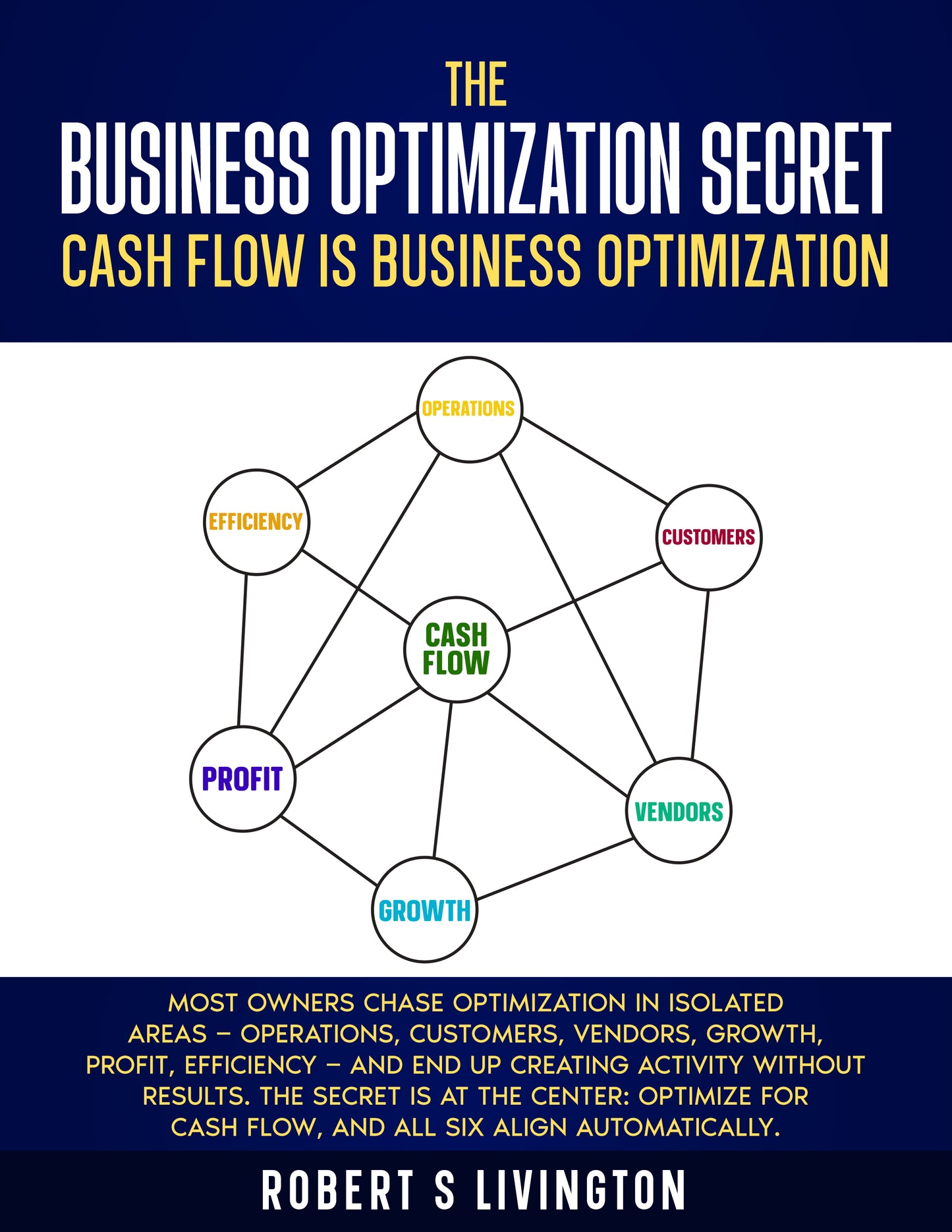
The Business Optimization Secret
The Business Optimization Secret
Couldn't load pickup availability
Note: A valid email address is required at checkout. Your digital download link will be sent to that email.
Important After Purchase
After completing your purchase, please check your inbox and your spam/junk folder.
You will receive two emails:
-
Purchase confirmation email
-
Product access email with your download or access instructions
If you don't see both emails within a few minutes, please check your spam or junk folder before contacting support.
The Business Optimization Secret Hidden in Plain Sight™
Cash Flow Is Business Optimization
Why Better Business Decisions Begin with Cash Flow
Cash Flow Creates Options™
Your business may be profitable. Sales may be growing. Your team may be working harder than ever.
Yet cash flow remains under pressure.
You invest in process improvements, technology, customer service, inventory, and growth. Each initiative makes sense individually. But the business doesn't necessarily become financially stronger.
Why do so many business improvement efforts fail to produce lasting financial results?
Because businesses frequently optimize individual activities without considering how those decisions affect the entire organization.
The Business Optimization Secret Hidden in Plain Sight™ introduces a different approach:
Maximizing cash flow is foundational to durable business optimization.
Cash flow isn't simply something to measure after business decisions have been made. It provides a financial perspective for evaluating those decisions in the first place.
This Executive Guide explains why cash flow should be central to business optimization—and how aligning management decisions around cash flow can strengthen operating performance, financial flexibility, and long-term business value.
The Problem: Improving Individual Activities Doesn't Necessarily Improve the Business
Consider the decisions businesses make every day:
-
Increasing inventory to improve customer service.
-
Extending payment terms to attract new customers.
-
Investing in equipment to improve productivity.
-
Pursuing additional sales to accelerate growth.
-
Improving quality while increasing production costs or cycle times.
-
Expanding operations before understanding the cash required.
Each decision may be justified.
But each can also create financial consequences that are not immediately visible in reported profits.
A business can become more efficient, more profitable, and more successful at generating sales—while becoming less capable of financing its operations and growth.
The guide explains why sustainable optimization requires more than isolated improvement projects.
It requires system discipline: a consistent approach to aligning decisions, priorities, and execution around the financial realities of the business.
What You'll Discover Inside This Executive Guide
1. Why Business Optimization Efforts Fail
Discover why conventional improvement initiatives sometimes create considerable activity without producing sustainable financial improvement.
The guide examines the limitations of optimizing departments, processes, and performance measures independently.
You'll explore why cash flow provides a unifying perspective for evaluating whether individual improvements strengthen the business as a whole.
2. The Growing Broke Death Spiral
Can a profitable, growing business actually become financially weaker with every additional sale?
Yes.
The guide explains the Growing Broke phenomenon—when growth consumes working capital faster than the business can generate sufficient cash to support it.
You'll examine:
-
Why additional sales often require more investment in inventory and receivables.
-
How customer payment timing affects growth financing.
-
Why profits and cash availability can move in different directions.
-
The five stages through which growth-related cash pressure can develop into a financial crisis.
-
Warning signs that owners and managers should recognize before cash pressure becomes critical.
The central lesson: Growth must be evaluated for its cash requirements, not simply its revenue and profit potential.
3. The Profit Delusion
A profitable income statement doesn't necessarily mean a financially healthy business.
This chapter explains the difference between accounting profitability and cash availability through numerical illustrations and operating examples.
You'll discover why:
-
Strong profits can coexist with declining cash balances.
-
Customer collections, inventory purchases, capital expenditures, and financing activities affect cash differently from reported earnings.
-
Improving margins doesn't automatically solve working capital pressure.
-
Profitability alone provides an incomplete picture of business financial strength.
The objective isn't to disregard profitability.
It's to understand why profit must be evaluated alongside the cash flow consequences of business decisions.
4. Why Cash Flow Is the Foundation of Business Optimization
This chapter introduces the guide's central operating philosophy.
Rather than treating cash flow as a separate finance department responsibility, it examines how cash flow connects decisions throughout the organization.
The guide explores the relationships between:
-
Customer collections and customer management.
-
Inventory investment and operating efficiency.
-
Supplier payment terms and purchasing decisions.
-
Pricing, costs, and profitability.
-
Growth and working capital requirements.
It also presents three business examples involving manufacturing, distribution, and food service operations, illustrating how cash flow-focused decisions can influence multiple aspects of business performance.
A reflection exercise encourages you to consider which operating and financial challenges most closely resemble your own business.
5. The Competitive Advantage Your Competitors Can't Buy
Stronger cash flow can provide benefits that extend well beyond financial stability.
This chapter examines how disciplined cash flow management can support:
Financial flexibility: Greater ability to manage obligations, finance growth, and respond to unexpected conditions.
Operational strength: Better coordination of inventory, collections, purchasing, and financial decisions.
Strategic positioning: Greater capacity to pursue opportunities when financially constrained competitors may be unable to act.
The guide also examines contrasting business experiences during periods of economic disruption and explains how financial, operating, and relationship advantages can reinforce one another over time.
6. Your Transformation Journey
Understanding the importance of cash flow is only the beginning.
This chapter introduces a five-phase framework for moving from reactive financial management toward a more disciplined approach to business optimization.
Phase 1 — Awareness: Recognize the relationship between cash flow, profitability, growth, and business decisions.
Phase 2 — Assessment: Examine the company's current cash flow position, predictability, and financial management practices.
Phase 3 — Alignment: Begin evaluating business decisions through their cash flow implications.
Phase 4 — Action: Establish disciplined management practices that connect financial objectives with operating execution.
Phase 5 — Advantage: Build financial flexibility and operating capabilities that support long-term competitive strength.
The chapter also identifies warning signs that may indicate the need for a different approach to managing the business.
Real-World Examples and Practical Management Perspectives
This guide goes beyond presenting a philosophy.
It uses business scenarios, financial illustrations, and historical examples to explain how management decisions affect cash flow.
These include:
-
A profitable distributor experiencing growing working capital pressure.
-
A manufacturer confronting cash constraints despite healthy margins.
-
A distributor working to reduce cash flow volatility.
-
A food service business addressing inventory waste and operating inefficiency.
-
Businesses responding differently to economic uncertainty because of their financial management practices.
These examples illustrate the financial and operating relationships discussed throughout the guide. They are not guarantees or predictions of results for another business.
The purpose is to help you recognize similar relationships and questions within your own company.
Who Should Read This Guide?
The Business Optimization Secret Hidden in Plain Sight™ is written for owners and executives of established, product-based small and mid-sized businesses.
It is particularly relevant to leaders in:
-
Manufacturing.
-
Wholesale and distribution.
-
Industrial and commercial products.
-
Consumer packaged goods.
It is especially useful if your company is profitable but cash remains tight, growth continually requires additional financing, operating improvements aren't translating into stronger financial performance, or too many important decisions depend on the owner's constant intervention.
What You Receive
A 38-page digital Executive Guide by Robert S. Livingston, Founder of BusinessWiser™.
The guide includes six chapters, an introductory discussion of system discipline, financial and operating examples, a reflection exercise, a five-phase transformation framework, and a concluding introduction to the BusinessWiser™ Cash Flow Mastery System.
This is an educational Executive Guide—not a financial analysis engagement, software application, or standalone calculator toolkit.
Frequently Asked Questions
Is this an accounting or financial reporting guide?
No.
Although it discusses profitability, working capital, and cash flow, its primary focus is business optimization and executive decision-making.
It explains why financial consequences should be considered when evaluating operating and strategic decisions.
How is this different from a conventional business improvement guide?
Most improvement approaches concentrate on individual functions or processes.
This guide examines why those improvements need to be coordinated around a common financial objective.
It introduces cash flow as the central perspective for evaluating whether business decisions are contributing to sustainable performance.
Will this guide tell me exactly how to improve my company's cash flow?
It introduces the management principles, examples, warning signs, and transformation approach that can help you evaluate your business differently.
It does not analyze your company's financial statements or provide company-specific recommendations.
Does this purchase include the Cash Flow Mastery System?
No.
This Executive Guide introduces the philosophy behind BusinessWiser™ and explains how the complete Cash Flow Mastery System supports implementation.
The complete system is a separate product.
What is the most important takeaway?
Business optimization isn't simply about improving individual activities. It's about aligning decisions so that improvements strengthen the business as a whole.
Cash flow provides a practical financial perspective for achieving that alignment.
The Bottom Line
You can improve sales, profitability, customer service, operating efficiency, and growth—and still create financial pressure if those improvements aren't properly coordinated.
The Business Optimization Secret Hidden in Plain Sight™ challenges owners and executives to think differently about what it means to optimize a business.
It explains why sustainable improvement requires system discipline, coordinated decisions, and a clear understanding of cash flow consequences.
The objective is not simply to build a busier business.
It's to build a financially stronger business with greater flexibility, resilience, and long-term opportunity.
Better Decisions. Stronger Cash Flow. More Options.
Cash Flow Creates Options™
Disclaimer
The materials, systems, and frameworks offered are for educational and informational purposes only. They are designed to support business learning and decision-making and are not intended to provide legal, tax, accounting, or financial advice.
Examples and historical results are illustrative and do not represent typical or guaranteed outcomes. Results vary based on each company's circumstances, management decisions, implementation, and market conditions.
Users should consult qualified professional advisors before making significant business decisions.
Share