BUSINESSwiser Digital Content
BusinessWiser™ Dynamic Duo
BusinessWiser™ Dynamic Duo
Couldn't load pickup availability
Note: A valid email address is required at checkout. Your digital download link will be sent to that email.
Important After Purchase
After completing your purchase, please check your inbox and your spam/junk folder.
You will receive two emails:
-
Purchase confirmation email
-
Product access email with your download or access instructions
If you don't see both emails within a few minutes, please check your spam or junk folder before contacting support.
The BusinessWiser™ Dynamic Duo
Two Executive Guides. 213 Pages. One Powerful Perspective on Business Decisions and Cash Flow.
Better Decisions. Stronger Cash Flow. More Options.
Why do some profitable businesses continually struggle with cash?
Why can two companies with similar sales and profits have dramatically different financial flexibility?
And why do so many business owners spend their time managing cash-flow problems instead of examining the decisions that helped create them?
The answers go well beyond accounting.
The BusinessWiser™ Dynamic Duo brings together two complementary Executive Guides that challenge conventional thinking about cash flow and explain its relationship to business decisions, financial strength, owner wealth, and the choices available to you.
Written by Robert S. Livingston, Founder of BusinessWiser™, these publications draw on more than four decades of financial, operating, executive, and entrepreneurial experience, including seven years of structured engagement with owner-led product businesses.
Together, they examine two fundamental questions:
Why does stronger cash flow matter so much?
And how do the decisions made throughout your business influence the cash flow you ultimately experience?
Understanding both can change how you think about running your business.
Executive Guide 1
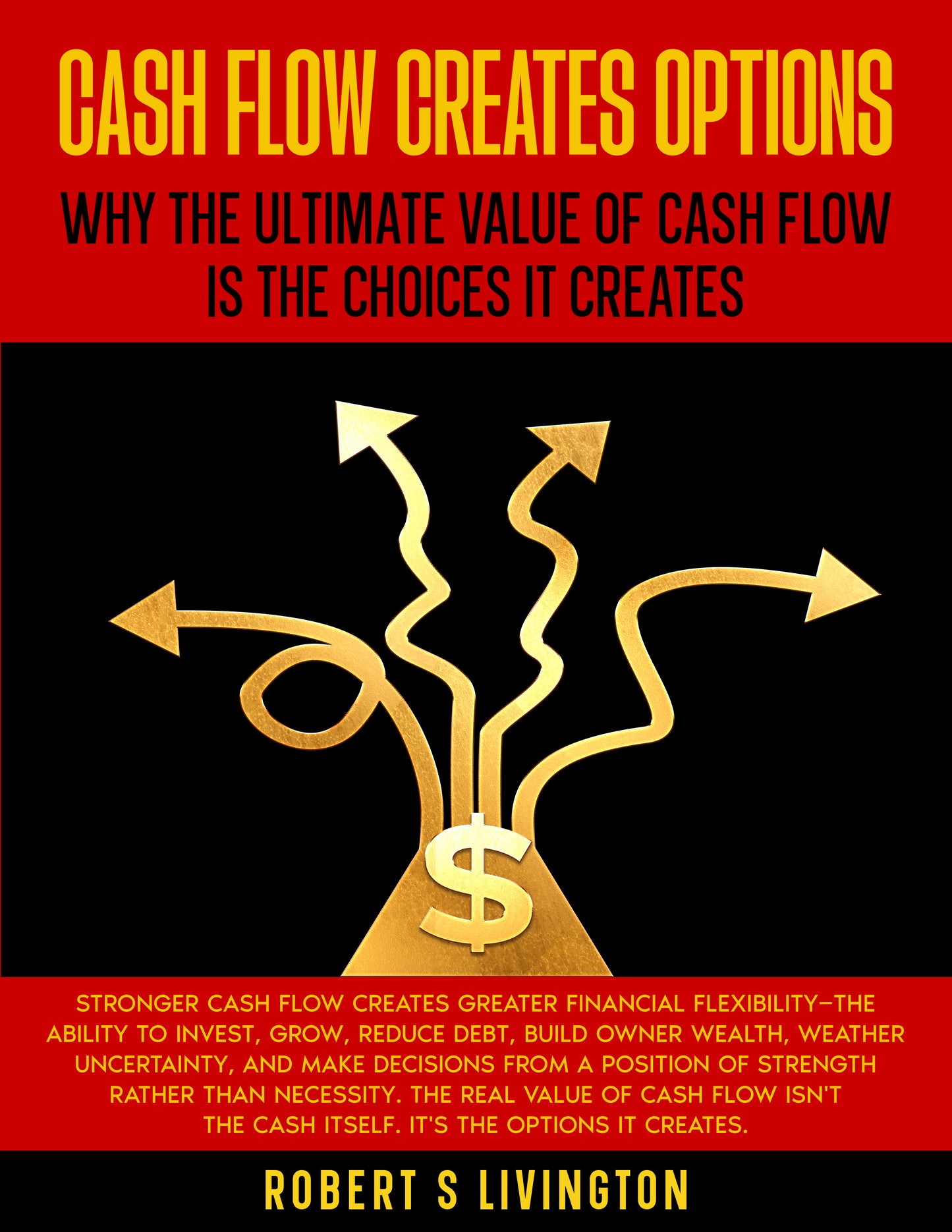
Cash Flow Creates Options™
Why the Ultimate Value of Cash Flow Is the Choices It Creates
101 Pages | Nine Chapters
Most business owners understand that cash flow is important.
They need cash to pay employees, purchase inventory, satisfy suppliers, service debt, and keep the business operating.
But those are only the immediate requirements.
The greater strategic value of cash flow is the financial flexibility it can create.
That flexibility gives owners and executives the ability to evaluate alternatives, make investments, respond to uncertainty, and shape the future of their businesses.
It also provides something less obvious but equally important:
The ability to make decisions from a position of strength rather than necessity.
This Executive Guide explores why cash flow matters far beyond the balance in your bank account.
What You'll Discover
1. The Real Value of Cash Flow Is Optionality
Understand why the ultimate benefit of stronger cash flow is having more viable choices—and why financial flexibility can be valuable even when you choose not to act.
2. The Option to Operate From Strength
Examine how financial pressure changes the decisions owners make, weakens negotiating flexibility, and can force businesses to accept alternatives they would otherwise reject.
3. The Option to Grow—or Not to Grow
Discover why growth is not automatically the right decision and how financial flexibility allows owners to evaluate opportunities without being driven by desperation or the pursuit of revenue alone.
4. The Option to Say No
Understand why the ability to reject unattractive customers, unfavorable terms, questionable investments, and unnecessary commitments can be as valuable as the ability to say yes.
5. The Option to Navigate the Unexpected
Explore how stronger financial flexibility can help businesses respond to setbacks, uncertainty, changing markets, and unexpected opportunities without sacrificing long-term priorities.
6. The Option to Invest in the Future
Learn why the financial capacity to invest in people, equipment, technology, capabilities, and strategic initiatives matters to the long-term strength of the enterprise.
7. The Option to Build a Stronger, More Successful Business
Consider what business success should mean beyond revenue growth and accounting profitability—and how financial strength can support a more resilient, valuable enterprise.
8. The Option to Build Owner Wealth
Understand the distinction between building a valuable company and building personal financial security, and why those objectives should be considered together.
9. The Option to Build the Life You Want
Examine the relationship between business ownership, financial independence, personal priorities, and the freedom to determine what role the business should play in your life.
The Central Lesson
Cash flow is not the ultimate destination.
It is a resource that can expand the choices available to your business and to you as its owner.
The guide challenges you to look beyond financial performance and ask:
What options is my business creating—and which options are we losing because of financial constraints?
Executive Guide 2
Most SMBs Don't Have a Cash Flow Problem. They Have a Decision Problem.™
How Better Business Decisions Create Stronger Cash Flow—and More Options
112 Pages | Ten Chapters
When cash flow becomes a problem, attention naturally turns to Finance.
What happened to the cash?
Why did receivables increase?
Why is inventory consuming so much money?
Why are profits improving while borrowing requirements continue to grow?
Financial reports help identify the results.
But those results frequently originate in decisions made throughout the business—often weeks or months earlier.
Cash flow is not simply an accounting result. It is a management result.
This Executive Guide challenges owners and executives to look beyond the financial statements and examine the decisions, commitments, and operating activities that influence cash flow.
What You'll Discover
1. Cash Flow Is a Management Result
Understand why Finance measures and reports cash flow, but decisions throughout the organization help create it.
2. The Decision Behind the Number
Learn to look beyond financial results and ask what management decisions, operating activities, and business circumstances produced them.
3. When Good Decisions Create Bad Cash Outcomes
Discover why decisions that make sense operationally can still create unexpected cash requirements—and why a negative cash consequence does not automatically mean a decision was wrong.
4. Growth and Revenue Decisions
Examine how growth strategies, pricing, customer selection, sales terms, and revenue decisions influence profitability, working capital, and cash flow.
5. Margin and Operating Decisions
Explore how purchasing, product costs, operating expenses, staffing, and other business commitments influence financial performance and cash generation.
6. Working Capital Decisions
Understand how inventory, accounts receivable, and accounts payable reflect decisions made throughout the business—and why those decisions can absorb substantial amounts of cash.
7. Investment, Financing, and Owner Capital Decisions
Examine the cash-flow consequences of capital expenditures, borrowing decisions, and owner distributions, including how today's commitments can influence tomorrow's financial flexibility.
8. Decisions Don't Happen in Isolation
Discover how decisions in one area of the business can create financial consequences elsewhere—and why managing individual functions without understanding their interrelationships can produce unintended results.
9. Better Decisions Begin With Better Questions
Learn to approach financial results with questions that reveal underlying decisions, competing objectives, timing differences, and potential consequences.
10. From Cash Flow Management to Decision Management
Explore the shift from responding to cash-flow results after they occur toward considering cash-flow consequences while important business decisions are being made.
The Ten Primary Cash Flow Drivers
Throughout the guide, you'll examine how decisions influence ten areas:
-
Growth
-
Pricing
-
Cost of Goods Sold
-
Operating Expenses
-
Inventory
-
Accounts Receivable
-
Accounts Payable
-
Capital Expenditures
-
Debt
-
Owner Distributions
These drivers provide a practical way to connect business decisions with financial outcomes.
The guide does not attempt to turn each driver into a technical implementation program. Its purpose is to strengthen the management thinking behind the decisions that influence them.
The Central Lesson
The cash flow your business experiences today often reflects decisions made yesterday.
And the decisions you're making today are already influencing tomorrow's cash flow.
The guide challenges you to ask:
What decisions created the cash flow we're experiencing—and what financial consequences might our current decisions create?
Why These Two Executive Guides Belong Together
The two publications examine different sides of the same fundamental business relationship.
Cash Flow Creates Options™ explores the consequences of financial strength.
It explains why stronger cash flow can create greater flexibility, resilience, investment capacity, enterprise value, owner wealth, and personal freedom.
Most SMBs Don't Have a Cash Flow Problem. They Have a Decision Problem.™ explores the origins of financial performance.
It explains how management decisions throughout the business influence the cash flow ultimately available to support those choices.
Together, they establish the foundation of the BusinessWiser™ philosophy:
Better Decisions. Stronger Cash Flow. More Options.
The first guide helps you understand what stronger cash flow makes possible.
The second helps you understand how business decisions influence the cash flow needed to make those possibilities real.
That is what makes the Dynamic Duo more valuable together than either perspective alone.
What You'll Gain From Reading Both Guides
The BusinessWiser™ Dynamic Duo is designed to help you:
-
Understand why profit, revenue growth, and cash flow can tell different stories about business performance.
-
Recognize the strategic value of financial flexibility and the ability to make decisions from a position of strength.
-
Understand why cash flow is influenced by decisions made across the entire organization—not just in Finance.
-
Examine the ten primary Cash Flow Drivers through a management decision-making lens.
-
Recognize how apparently reasonable decisions can create unintended cash requirements.
-
Understand why financial consequences may emerge long after the original decisions were made.
-
Appreciate the relationship between financial strength, enterprise value, owner wealth, and personal freedom.
-
Begin asking better questions before committing financial resources.
-
Shift your management perspective from simply reviewing financial results to understanding the decisions behind them.
These guides are designed to improve executive understanding and decision-making perspective—not to provide technical implementation procedures or automated financial analysis.
Who Is the Dynamic Duo Designed For?
The BusinessWiser™ Dynamic Duo was developed for owners, CEOs, presidents, and senior executives of owner-led product-based small and mid-sized businesses, particularly those involved in:
-
Manufacturing
-
Wholesale and distribution
-
Industrial and commercial products
-
Consumer packaged goods
-
Other inventory-intensive product businesses
It is especially relevant to business owners who are profitable but regularly concerned about cash, are pursuing growth that requires increasing financial commitments, or want their businesses to create greater long-term financial and personal flexibility.
You do not need advanced financial training to benefit from these publications.
They are written from the perspective of business ownership, executive leadership, and real-world management experience.
What You Receive
Your purchase includes two complete digital Executive Guides by Robert S. Livingston:
1. Cash Flow Creates Options™
Why the Ultimate Value of Cash Flow Is the Choices It Creates
101 pages covering nine chapters.
2. Most SMBs Don't Have a Cash Flow Problem. They Have a Decision Problem.™
How Better Business Decisions Create Stronger Cash Flow—and More Options
112 pages covering ten chapters.
Total: 213 pages across 19 chapters.
Both publications are delivered electronically for convenient reading and future reference.
The Dynamic Duo is a standalone educational product. It is not the complete BusinessWiser™ Cash Flow Mastery System, a consulting engagement, or a personalized financial analysis.
Frequently Asked Questions
Are these two guides primarily about improving cash flow?
They examine the relationship between cash flow, management decisions, and financial flexibility.
The first explains why cash flow matters and the choices it can create. The second examines how business decisions influence financial outcomes.
They are intended to strengthen executive understanding rather than teach specific technical cash-flow improvement procedures.
Why purchase both guides instead of just one?
Because they answer two complementary questions.
Understanding how decisions influence cash flow is valuable.
Understanding why stronger cash flow matters to the business and its owner is equally valuable.
Together, they connect the decisions you make today with the financial flexibility you want tomorrow.
Are these guides based on real business experience?
Yes.
The perspectives reflect more than four decades of financial, operating, executive, and entrepreneurial experience, together with historical work involving more than 50 consulting clients and approximately 120 participants in the former BusinessWiser™ Advisory Circle.
Both guides include business observations, examples, and situations that illustrate the principles being discussed.
Will I receive spreadsheets, calculators, or implementation software?
No.
The Dynamic Duo consists of two digital Executive Guides.
They are designed to strengthen management perspective, financial understanding, and decision-making awareness rather than provide software or implementation tools.
Is this appropriate for an owner without a finance background?
Yes.
The publications focus on business decisions and their consequences, using executive-level explanations rather than requiring advanced financial expertise.
How does the Dynamic Duo relate to the Cash Flow Mastery System?
The Dynamic Duo introduces two fundamental ideas behind BusinessWiser™:
Business decisions influence cash flow.
Cash flow creates options.
The separately available BusinessWiser™ Cash Flow Mastery System provides integrated frameworks and tools for applying cash-flow management disciplines within an operating business.
The Bottom Line
Every business owner makes decisions.
Decisions about customers.
Pricing.
Growth.
Inventory.
People.
Investments.
Financing.
And how much cash to retain or distribute.
Those decisions influence the financial position of the business.
And that financial position influences which choices will be available tomorrow.
The BusinessWiser™ Dynamic Duo helps you understand both sides of that relationship.
213 pages. 19 chapters. Two complementary Executive Guides. One essential business perspective.
Better decisions can contribute to stronger cash flow.
Stronger cash flow can create greater financial flexibility.
And greater financial flexibility creates more options—for your business, your future, and your life.
Better Decisions. Stronger Cash Flow. More Options.
Cash Flow Creates Options™
Disclaimer
The materials, systems, and frameworks offered are for educational and informational purposes only. They are designed to support business learning and decision-making and are not intended to provide legal, tax, accounting, investment, or other professional advice.
Examples, observations, and historical business situations are provided for illustration and do not represent typical or guaranteed results. Actual outcomes depend on each company's circumstances, management decisions, implementation, and market conditions.
Users should consult qualified professional advisors before making significant business or financial decisions.
Share